
* * *
Ok, you really have to hear the background of this next post. The other day I was tweeting with a guy whose Twitter handle is @fivesolasguy, (Brian Thornton.) He responded to a couple of tweets of mine and I have to be honest with you, his words felt very familiar to me. The following is a good sampling of our conversation.
* * *
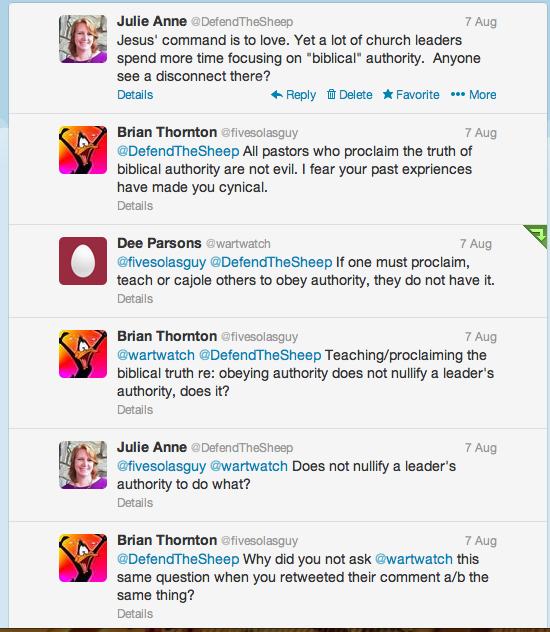


* * *
Eventually, I got tired of the same runaround and so I said “gotta run” or something similar a couple of times. I continued to get more tweets after saying I had to go (notifications come to my smart phone) and I didn’t want to have to keep picking up my phone for the same guy tweeting the same ol’ stuff and so I blocked him. I think I have only one other person blocked in my 1+ yrs of tweeting.
Well, yesterday, I noticed Mr. Thornton came here to the blog and posted a couple of comments. He questioned why I blocked him on Twitter. So, I went back to Twitter to see what was going on. Apparently, he had tweeted and tagged me quite a bit. I found the evidence on Aug. 9 in which he spouted off publicly about me for blocking him. JA did something she doesn’t allow her kids to do – she rolled her eyes.
* * *

* * *
Wow – those are 6 tweets in a row. There were more, too. I couldn’t tell if the tweeting occurred all at once or throughout the day. I realized that this guy was obviously trying to get some message across to me and not satisfied with my earlier responses and so I gave him an offer to say whatever he’s trying to say in a paragraph or two and I’d post it here on the blog. (You might consider clicking on that link. The exchange is pretty funny – – one of our regular readers, Eric Fry, saw what was going on and put his TX cowboy boots on. Yea, he cut to the chase.) I figured why not – we could try to discuss it here with complete sentences and paragraphs without the Twitter character limitations and just be done with it already.
Hey, what do you know, he took me up on it. You can tell from the tweets above that we both were getting frustrated. Twitter can be very effective or it can be very ineffective. Our conversation was not getting anywhere.
But check out what he wrote. I can’t believe it’s the same guy. It definitely gives more insight into his tweets. The only edit I made was to break up a long paragraph, otherwise, this is exactly Mr. Thornton’s content. I’m looking forward to the discussion.
* * * * * *
A Call for Reasoned Discernment Before Judgment Is Made Upon Others
My wife and I have experienced what is known as spiritual abuse at the hands of a pastor who went to great lengths to “lord it over” his flock. He would arrive at your doorstep unannounced to rebuke you for not attending a service, have others call you out and rebuke you for some comments you made at a small group gathering, and would even verbally chastise you and threaten to remove you from membership if you did not repent of a particular sin he was convinced you had.
When I finally concluded that this guy was beyond the possibility of being reasoned with, I removed my wife and family from his spiritually oppressive influence. This guy was off the chain, so to speak, and I would not allow him to exert his unbiblical and sinful attempts to control us any longer.
My experience had made me a prime candidate to resist any future submission to a pastor/elder/shepherd (it did, in fact, result in me being hyper-critical for several years following that experience). But, in spite of what we went through, I remain convinced of the Bible’s teaching concerning the submission of Christians to their church leaders. Sadly, though, I fear that there are many who experience similar things that we did who become overly cynical, distrusting, and critical of anyone who teaches the biblical truth concerning the authority of church leaders over their congregations. Simply put, bad experiences do not negate the truth of God’s Word. And they don’t give us unfettered license to rail against anyone we believe is abusing their authority.
One of the main mistakes we can make (especially those of us who have experienced abusive practices firsthand from church leaders) is that, going forward, we fail to give others the benefit of the doubt. Paul said that love “bears all things, believes all things, hopes all things, endures all things”, and I believe part of what Paul is saying there is that our love for one another inside the church will include an attitude and heart of trust, rather than distrust. Our love for one another, rooted in the common bond we have IN Christ, will (should) translate into carefully researched conclusions and comments regarding another’s supposed position on church authority, for example. That love will result in, not publicly expressed suspicion the moment we see a red flag or questionable information, but will instead lead us to make sure that we are counting others as more important than ourselves, which will hopefully result in us reserving judgment until we are sure of the truth. I have been guilty of this more times than I can count.
Another common mistake we tend to make is that we will attack and judge and critique something based upon what someone has written rather than how what has been written actually gets fleshed out in real life. For example, someone reads on a web site article about someone’s position on the church’s authority over a Christian, and they draw all sorts of conclusions and preconceived opinions, not based upon what actually occurs in real life, but rather based upon what was written. I have been guilty of this quite recently. I strongly disagreed with a particular “method” for doing something as it was written and explained on paper, and I began to passionately attack that method with much vigor and emotion. However, when I took a step back and decided to see how that method was actually being fleshed out in real life, my conclusions were completely opposite from my initial judgments. We can erect all manor [sic] of straw men that we can easily knock down (or burn in effigy), when the truth is all we’ve done is malign another member of the body of Christ for no good reason. Make no mistake, there are those who take advantage of others and abuse their authority in the church. And they must be exposed and stopped. But, every red flag is not a cause for misinformed declarations against others who profess Christ. When we do that, we very well may be bringing down someone who is truly on our side. And for what reason? Because we didn’t give the benefit of the doubt, or we didn’t do our homework, or we attacked some words in an article rather than examined real life actions. When that happens, we have acted no differently and no better than those we are accusing of wrong-doing.
I pray we would all grow in the grace of our Lord and Savior as we bear, believe, hope, and endure all things for the well-being of our brothers and sisters in Christ. May we seek to be well-informed, truly discerning members of the church.
Brian Thornton
 Spiritual Sounding Board
I like this discussion, Julie Anne. I’m glad you and Brian could take this to complete sentences and paragraphs rather than Twitter. I think Twitter, while enjoying certain advantages, also makes it really easy to misinterpret others. That said, I can understand why Brian’s tweets frustrated/triggered you, and I’m glad to read what he wrote above.
As far as biblical authority, I believe Hebrews 13:17 (traditionally translated “obey your leaders and submit to their authority”) has been mistranslated. The word for “obey” is not obey, it actually means “allow yourself to be persuaded by.” Spiritual authority in the New Testament is not based on position (pastor, elder, whatever) but is instead based on persuasive character, i.e. the person must possess the truth of God and also be a trustworthy person.
That said, folks who have spiritual authority cannot force others to submit to them. Instead the New Testament commands them to live such worthy, wise lives that other Christians will recognize their spiritual astuteness and follow them for their own good.
Frank Viola explains this very well in “Reimagining the Church.” I’d recommend it to anyone, no matter where you fall on the spectrum. While Frank and I might differ somewhat on what the church can look like, we are in substantial harmony about the nature of spiritual authority in the New Testament. He writes well–check out this book.
Since most English Bibles mistranslate Hebrews 13:17 (a function of Bible translators using their own experience with church and secular hierarchy as a filter to translate the passage), I can totally understand why many Christians believe that they must submit to the authority of pastors and elders. I sure did.
I didn’t really understand what was going on in this passage until I wrote a paper about it at Dallas Seminary. While I don’t claim to be the fount of all wisdom, if anyone wants a different perspective, I’d be happy to send you a link to it. Just email me at libertyforcaptives@gmail.com
Thanks again, Julie and Brian, for a worthy discussion.
LikeLike
I’m afraid I rabbit-trailed on spiritual authority. I agree with Brian that we should think the best of others until experience proves that someone is unsafe. But that doesn’t mean we have to take our armor off, especially if we’ve been wounded a thousand times in the same place. imho
LikeLike
Hey Steve – How’s your sweet new baby?
The Heb 13;17 verse is a hot button for many of us survivors. I’ve written a series on it as well and also stumbled across your blog when searching that particular verse one day (which is how I found you and I’m so glad I did).
What bothers me is that some pastors do pull out this verse and use it to show their authority. Frankly, any pastor who needs to pull the authority card needs a heart check. I don’t think you get true heart-felt submission if authority is demanded.
Oh, and yes, that Twitter thing. That was a big lesson for me. Of course I knew it already, but seeing it played out here really shows that we cannot be so quick to judge a tweet. I’ve been guilty of that, sadly 😦
LikeLike
Brian is putting forth an argument for submission to ecclesiastical authority that is weak as it infringes on freedom of opinion and expression, as well as its understanding of authority.
Brian’s argument is attempting to enforce adherence to inerrantism and literalism with his statements concerning “biblical truth”, as well as implying that there is only one correct way to interpret and incorporate his vision of truth into church life, whether adhering to inerrantism or not. This argument is specious at best, as seen in the claim that women must be relegated to a secondary status within the church in order to be acceptable to God. Different churches have come to very different conclusions and practices concerning women, so I have to wonder if Brian would say that they are not Christian.
As to the nature of authority, it must have a mandate. Clearly, in a Biblical context, the mandate comes from God, no matter what type of critical analysis we use, so long as the argument includes only Christians. Most of us here will readily concede that point, so it needs no elaboration.
However, the nature of authority, in and of itself, has four salient features pertinent to this discussion: Mandate, Conditionality, Limit of Power, and Scope.
We’re agreeing on mandate, so Conditionality comes next. This applies when authority gives an order that is unlawful, or in this context, un-Godly. Just as a military agent has a duty to disobey an illegal order from a superior, this also must apply in the case of an elder issuing an un-Godly and/or unlawful directive to a congregant, such as to not contact police with allegations of sexual abuse. In cases such as this, it is a Christian’s duty to disobey the authority and advocate for the person making the allegations. When the conditions are unlawful or un-Godly, we are under no obligation to comply.
Authority also has a limit of power. While this is not spelled out in the Bible, common sense tells us what those limits are. As in Brian’s post, a church authority is acting beyond the reasonable limits of power when trying to enforce attendance or expelling a member without due process. Congregants are free to willingly choose to give more power to leadership, and this is demonstrable in churches that have dress codes, dietary restrictions, etc., but these can only apply to an individual congregation or denomination, and the leadership has no power to declare that someone is not a Christian for leaving that system for another. Such an action would not only be outside of the limit of power, but also of the scope of the authority.
Regarding scope, the authority cannot act outside of its sphere of influence. It limits authority not only to its specific congregation or denomination, but also to what areas of life into which it can intrude. Protestants are outside of the scope of authority of the Catholic church in all areas, no matter what the Holy See may claim. Likewise, a member of one church is outside of the scope of authority of another church, and under no obligation to obey or defer to them. Within each church, a Christian’s actions that are not sinful are outside of the scope of authority of any eldership. Opinions, friendships, job choice, musical taste; these are some examples of things that are outside the scope of authority of any eldership.
With this understanding of authority, no one Christian has the right to demand of another that they not question the words, policies, and actions of anyone who wishes to be a leader within the church. Rom. 13:1 give us some more insight into this issue: “Every person is to be in subjection to the governing authorities. For there is no authority except from God, and those which exist are established by God.” Under the authority of US law, (which scripture tells us is established by God) we are obligated to obey the laws, but we are also given freedoms to exercise. The one that Brian is arguing against is the freedom of expression. We are free under the law and God to question leaders in other churches, insofar as these leaders are expressing themselves publicly for all to see. We also have a God-given duty to confront these leaders when we honestly believe their policies are oppressive to people.
The real point of Brian’s essay is that we should exercise a more loving and compassionate tone in discussions about these criticisms, more in line as being Christ-like. I agree with that. But any argument for that would be better served by leaving out the topic of submission to authority and focusing on mercy, love and grace. But, as we are all flawed humans, this is something that we will all have to work towards, and can’t be expected to get it perfect every time. We can all admit that we have been less than charitable towards other Christians at times. But, even Christ tore into the money changers in anger at their abuse of the poor, so our less-than-charitable responses may not be in the wrong.
LikeLike
Julie Ann:
I do not submit to the authority of leaders in the church. It would be the rare man or women of God that would not abuse their authority IMO.
LikeLike
Some if not most translations tend to take the King James version in translating instead of the original languages and text.
I remember when translations of the Bible first came out being taught to put a translation next to the King James. If both are similar in meaning, that translation was the one you wanted. The problem with the King James however is that King James was advocating ruling over, obeying, submission etc because well…he was King James.
I agree with “Liberty for Captives” rendering of this passage. I have heard this rendering preached by Wade and having looked at it through various sources myself have come to the same conclusion. I think God knew the human heart enough to know that ministers would tend to become power hungry, looking into every aspect of a person’s life and attempting to control. We don’t become Christians to be led and abused by power. We become Christians to follow Christ. The word Christian means Christ follower not men follower as the Apostle Paul made clear in 1 Corinthians 1:12.
LikeLike
It’s funny, I’m sitting here thinking: what does submit to authority really mean? What does that look like for a pastor/congregant? Brian, can you please give me an example of a congregant submitting to the authority of a pastor?
This reminds me of our many discussions on complementarianism and how so many of those guys promoting it, really don’t explain it very well in the nuts and bolts sense of wife submitting to her husband.
LikeLike
My response to his question would have been not only no, but hell no, and not only hell no, but **** NO. They don’t have ANY authority over ME. The job of a teacher is to teach. The job of a bishop (which is defined as SUPERINTENDENT) is to be in charge of a task, such as Stephen, who was IN CHARGE of making sure that the widows were fed, because the apostles were NOT GOING TO WAIT ON TABLES, while they spread the gospel. They don’t have authority OVER anyone, period.
As you can see, from that perspective, the superintendent, or Bishop, was in the area of serving others, and that was his authority.
Matthew 7:29
For he taught them as one having authority, and not as the scribes.
Mark 1:22
And they were astonished at his doctrine: for he taught them as one that had authority, and not as the scribes.
Do you see how the word authority is used there?
Next, look at the word “BUT”, and MINISTER in verse 26
Matthew 20:24-26
24 And when the ten heard it, they were moved with indignation against the two brethren.
25 But Jesus called them unto him, and said, Ye know that the princes of the Gentiles exercise dominion over them, and they that are great exercise authority upon them.
26 But it shall not be so among you: but whosoever will be great among you, let him be your minister;
Next, look at the word, “BUT” and “MINISTER” in verse 43
Mark 10:41-43
41 And when the ten heard it, they began to be much displeased with James and John.
42 But Jesus called them to him, and saith unto them, Ye know that they which are accounted to rule over the Gentiles exercise lordship over them; and their great ones exercise authority upon them.
43 But so shall it not be among you: but whosoever will be great among you, shall be your minister:
Next, notice the word “BUT” AND the word “SERVE”.
Luke 22:25-26
25 And he said unto them, The kings of the Gentiles exercise lordship over them; and they that exercise authority upon them are called benefactors.
26 But ye shall not be so: but he that is greatest among you, let him be as the younger; and he that is chief, as he that doth SERVE.
MINISTER: Strong’s Concordance Greek Ref #1249
diakonos
An attendent, i.e., a waiter (at table or in other menial duties; specially a Christian teacher and pastor (techn. a dedacon or deaconess)
Other English words used for diakonos: deacon, minister, SERVANT.
SERVE: Strong’s Concordance Greek Ref #1247
diakoneo (from 1249 (above)
To be an attendent, i.e. WAIT UPON (mentally, or as a host, friend, or [figurative] teacher); techn. to act as a Christian deacon.
Other English words used for diakoneo: (ad-)minister (unto), SERVE, use the office of a deacon.
And, it might surprise people to know that there are more than one Greek definition to the word authority.
What is the purpose of Authority here: To Edify, NOT FOR DESTRUCTION.
What does edify mean? To UPLIFT.
2 Corinthians 10:8 (AUTHORITY Greek Ref #1849)
For though I should boast somewhat more of our authority, which the Lord hath given us for edification, and not for your destruction, I should not be ashamed:
Luke 22:25 (AUTHORITY: Greek Ref #1850)
25 And he said unto them, The kings of the Gentiles exercise lordship over them; and they that exercise authority upon them are called benefactors.
1849 IS MUCH DIFFERENT THAN 1850.
1849:
privilege, delegated influence
As in the use of 2 Cor 10:8, Authority delegated to Paul from God to UPLIFT the people.
1850:
to control
It’s funny how people like Brian has no knowledge of what authority the church leaders really have. They only authority that they have is to SERVE us, to FEED us, not to rule OVER us.
Now, based on THAT authority, delegated by God to uplift, let’s look at the following:
Hebrews 13:17
Obey them that have the rule over you, and submit yourselves: for they watch for your souls, as they that must give account, that they may do it with joy, and not with grief: for that is unprofitable for you.
Obey 3982 (NOT TO BE CONFUSED WITH 3980, WHICH BRIAN DOES) to convince (by argument, true or false); by anal. to pacify or conciliate (by other fair means); reflex. or pass. to assent (to evidence or authority), to rely (by inward certainty).
Other English words used: agree, assure, believe, have confidence, be (wax) confient, make friend, obey, persuade, trust, yield.
Rule 2233 To lead; fig. to deem
Other English words used: account, (be) chief, count, esteem, governor, judge, have the rule over (but we know the rule based on the above), suppose, think.
Submit 5226
TO SURRENDER
This form of surrender is meant as a “relax”, or in other words, “YOU DON’T HAVE TO WORRY ABOUT IT… I WILL TAKE CARE OF IT. I have authority to take care of you, and don’t worry…I am accountable to God.
From dictionary.com
verb (used without object)
6. to give oneself up, as into the power of another; submit or yield.
Noticing the alternate English words used, we can surmise that Hebrews 13:17 also states,
Trust those who are accountable, because they must give an account. They are accountable to God, the final authority. God gave them authority over you to edify (UPLIFT) you, not for your destruction.
Hebrews 13:7
7 Remember them which have the rule over you, who have spoken unto you the word of God: whose faith follow, considering the end of their conversation.
So, to sum it all up: NO ONE RULES a man or a woman in the way that Brian wishes to teach us.
Abused words used by Calvinists are:
Submit,
Authority
Obey
Rule
And a whole slew of others.
Ed
LikeLike
What I saw from the tweets? And then from what he said?
He could of ‘fleshed out’ concepts, words, etc before he decided he was going to get ganged up on. Sadly, he decided he was going to get ganged up on and blocked before he made it clear what the definitions were – or any other foundation purpose to start the conversation.
So he basically did the same thing he seems to be accusing others of. I doubt he noticed that to be honest. He did though. In these types of conversations those terms MUST be agreed upon before the conversation begins. It is what it is.
”’And they don’t give us unfettered license to rail against anyone we believe is abusing their authority.”’
These types of statements to me is a great example of parroting. They are repeating what they heard, and use it generally. They tend NOT to give good examples of how this was done. To be fair? Yes, I have seen parroting in the other direction as well.
Advocating, and speaking out against abusive practices – or ways of thinking, etc – isn’t railing against people. Also what he doesn’t acknowledge is sadly to many people are stuck in that cycle of an abusive church system, and not even realizing its abusive. When advocating you speak out about the habitual pattern? It can get people’s attention, and some will stop, read, and pray about it. Heck they may even find the courage to leave like he did. He isn’t giving benefit of the doubt towards the journey. If he had something in particular he didn’t like – say it, and start from there!
For example, my definition of ‘authority’ could be very different from someone else’s within the realm of faith. Some preacher’s seem to feel it means I’m the top dog – what I says goes – and everything I utter from my lips is so. You don’t like it your in sin, and I can show you all these verses to back me up. Some preachers can use parts of that, and others tend to go even further.
If a person truly has what I see as authority? It has nothing really to do with being my top dog, bossman in charge, etc. Those are worldly concepts. In the news recently, they had been speaking about Martin Luther King, Jr. He commanded authority, but not by telling people he is an authority so listen! He had a natural aura about him that did it for him. Chances are people will respect his rebuke WAY better, and actually consider what he has to say – compared to the demand man.
it is what it is.
If two people are going to have a conversation about ‘authority’ of clergy? They must define what that means to them first, because they throw out the baby with the bath water. Despite his claims? He did that with tweets. I mean how hard is it to explain what you mean by authority FIRST, and then continue the conversation? Seriously.
LikeLike
Forgive the cynicism, but I find it fascinating that a post that is as verbosely meaningless as Mr. Thornton’s above manages in this short time to generate a considerable length of commentary. I can neither agree nor disagree with his remarks, because they are abstract to the point of saying nothing. He talks about some unspecified “method” that he read and disagreed with and then the revelation of his error that took place when he considered the application of the method. Well, gee whiz, that’s compelling. The infallibility of the argument rests securely in the complete absence of any facts. A story without a story, that example. “I disagreed with what someone said, but then I saw that it worked. Therefore: Biblical authority.” The logic is almost as infallible as Scripture itself.
What should one expect from an argument that started on Twitter? We’ve gone from 140-character meaningless exchanges to 14,000-character meaningless exchanges.
I note also that the question “Does not nullify a leader’s authority to do what?” and all of its iterations was never answered. Arguing about whether an imperative middle voice verb in an ancient language should be rendered obey or be persuaded by and all the rest of this is rendered even more silly than it is in se, if there isn’t even an explanation of where to draw the authoritative line. “Simply put,” Mr. Thornton writes without, one suspects, the understanding of just how painfully simple the subsequent statement indeed is, “bad experiences do not negate the truth of God’s Word.” One wonders what that truth is supposed to be. I guess we agree that a pastor’s authority should not extend to banging on your door when you miss a service, threatening to excommunicate you, or compelling other parishioners to harass you by telephone. Is that it? It’s surely not in God’s word.
So if the sole authority is Biblical ….
I’m tired. I need to drink my tea.
LikeLike
This whole idea of “Biblical authority” is a completely foreign concept to me – so much so, that I have trouble even understanding HOW the abuse we read about on these Blogs can ever happen in the first place. Here’s why: I am a member of the the United Church of Canada – a Protestant denomination (I believe in the States they are still called Methodists; the United church is a melding of the Methodists, Presbyterians, and Congregationalists). I can honestly say that I have never heard the scriptures that are being quoted on here – no minister I’ve ever had has referred to them, that’s for certain. In our church, the ordained minister is a facilitator and repeatedly reminds us that she is working WITH US to provide leadership, help with resources, spiritual assistance, and guidance. We are a team. She doesn’t direct us; she suggests. She isn’t the authority; she’s a spiritual advisor. We value her input and defer to her on many issues (usually because she knows the ins and outs of ‘how things work’ and the proper procedure for such) but when we meet it is a give-and-take atmosphere where everyone’s input is valued. If an issue arises, we have a Ministry and Personnel Committee (of which I am a member) to deal with it. Since my background is steeped in egalitarianism (I’m also a High School teacher), I have a very difficult time figuring out exactly how these situations of spiritual abuse occur. I see two sides here: Men who demand complete authority and will settle for nothing less; and people (and the word ‘sheeple’ comes immediately to mind) who willingly submit to this kind of autocratic dictatorship – I have to tell you that it baffles me. I hurt for the people who get in this kind of situation – believe me, I do – but I can’t help but ask myself why anyone would want to be a part of an organization like that. It seems to me that everyone has the right to investigate the structure of any organization – find out, for instance, if the Elders (and other committees) have both women and men representatives; find out what kind of reputation the minister has; ask questions and get comprehensive answers. It seems to me that abuse stories like these are a big part of why the younger generation has turned off to religion – can you blame them??
Perhaps it’s time to get power-hungry megalomaniacs out of the pulpits before there’s no people left in the pews. . methinks this Blog is contributing to that effort. .
LikeLike
Julie Anne said: “It’s funny, I’m sitting here thinking: what does submit to authority really mean? What does that look like for a pastor/congregant?”
I’m wondering that too. One time in church there were these two women in the balcony who started banging away on tambourines during the congregational singing. The minister or someone on staff probably said something to one or both of them because it didn’t happen again. To me that would be an example of “being persuaded” or using “authority”. Can you imagine if anybody brought some instrument to play without permission during worship? (Tuba?) Anyway, that’s one example that happened that I can think of. What would be some others? I really think we need examples to understand this.
LikeLike
“A Call for Reasoned Discernment Before Judgment Is Made Upon Others”
The fact is, we all make unconscious “discernments” every day in the course of living. (Is it safe to cross this street, or is that car approaching too quickly? Should I eat these week old leftovers, or will they perhaps make me sick? Can I put off this dentist/doctors appointment, or will someone’s health suffer?) By implication, Mr. Thornton assumes that some of us have discerned “unreasonably” when we discern that pastoral authority, interpreted to mean “lordship,” often produces bad fruit. And we know that a good tree does not produce bad friut.
How many here who have children have ever had their child stick their fingers in an electrical socket more than once? I’ve had a few do it once. They never did it again. Is their discernment “unreasonable?” Or have they learned a very healthy aversion toward playing with the electrical socket? Should they wrongly judge all electrical sockets as being “abusive” because of a bad experience with one of them? And just how was it that electrical sockets got such a bad reputation as being dangerous to stick one’s fingers in to begin with? How unfair!
I think we are seeing a pattern beginning to emerge among church’s that interpret pastoral authority as “lordship” to be submitted to. And I’m not willing to keep sticking my fingers into those “sockets.” Others are free to continue to follow their consciences in regard to “submission to authority.” My fingers are fried! And so are many others.
LikeLike
Brian
Thank you for your guest post and participating here.
I’m very sorry for the “Spiritual Abuse” you and your family experienced. 😦
I also experienced “Spiritual Abuse” and now see it as a benefit…
The Abuse drove me to Jesus – And Jesus is the best – Yes? 😉
Jesus, did call Himself – The “ONE” Teacher – The “ONE” Leader.
You write…
“I remain convinced of the Bible’s teaching
concerning the submission of Christians to their **church leaders.**
In the Bible – I can NOT seem to find **church leaders** mentioned.
If the term “church leaders” is NOT in the Bible… How can you
“remain convinced of the Bible’s teaching concerning
the submission of Christians to their **church leaders.**”???
Sounds to me like maybe a MAN taught that to you – and NOT the Bible.
Did you ADD that term to the Bible?
Is that an acceptable practice – To ADD terms to the Bible?
LikeLike
You write…
“My experience had made me a prime candidate
to resist any future submission to a pastor/elder/shepherd…”
In the Bible
I can NOT find anyone in “submission to a pastor/elder/shepherd?”
If NO one in the Bible is in “submission to a pastor/elder/shepherd?”
Why would you recommend that to believers?
Sounds to me like maybe a MAN taught that to you – and NOT the Bible.
Did you ADD that term to the Bible?
Is that an acceptable practice – To ADD terms to the Bible?
LikeLike
Brian
You write…
“My experience had made me a prime candidate
to resist any future submission to a pastor/elder/shepherd…”
Was wondering – In the Bible
Can you name one of His Disciples who was called pastor or shepherd?
Or – Had the “Title” pastor or shepherd?
If, in the Bible, NOT one of His Disciples was called pastor?
If, in the Bible, NOT one of His Disciples had the “Title” pastor?
Maybe His Disciples knew something todays pastors do NOT?
LikeLike
Julie Anne
This is really, really, cool – What a great idea…
Offering a guest post to Brian – And Brian accepting…
I hope he joins in the comments… 😉
LikeLike
From Brian’s twitter-
“Brian Thornton @fivesolasguy 8 Aug
“Let them do this with joy and not with groaning, for that would be of no advantage to you.” #fb
Brian Thornton @fivesolasguy 8 Aug
“Obey your leaders (pastors) and submit to them, for they are keeping watch over your souls, as those who will have to give an account.” #fb ”
Well, I personally do not like how Brian inserted the word “pastors” into the verse.
Isn’t he assuming the leaders were their pastors??
LikeLike
“I can neither agree nor disagree with his remarks, because they are abstract to the point of saying nothing. He talks about some unspecified “method” that he read and disagreed with and then the revelation of his error that took place when he considered the application of the method. Well, gee whiz, that’s compelling. The infallibility of the argument rests securely in the complete absence of any facts. A story without a story, that example. “I disagreed with what someone said, but then I saw that it worked. Therefore: Biblical authority.” The logic is almost as infallible as Scripture itself.”
Thank you!
I see so much of this non thinking being around seminary trained young men and it scares me to death. In effect, given the illogic Brian was presenting I was sure he was advocating “the ends justify the means” when he wrote this:
“I strongly disagreed with a particular “method” for doing something as it was written and explained on paper, and I began to passionately attack that method with much vigor and emotion. However, when I took a step back and decided to see how that method was actually being fleshed out in real life, my conclusions were completely opposite from my initial judgments. “
LikeLike
Brian wants us to accept his premise of human authority in the Body of Christ. YET, he gives us an out, too, just in case they are abusive. In other words, he acknowledges our right to not submit to abusive leaders. But then, who decides what is abusive? And doesn’t that ability negate the whole premise of human authority in the Body? How would such an authority work? Doesn’t one “obey” an authority?
(Thanks Ed for doing the heavy lifting on the scripture that is always proof texted and by ignoring all the other “one anothers”, no lording it over, etc, etc)
I understand there is no mediator between us and Jesus Christ. There will no pastor standing with me before God. I am totally and completely responsible for how I have pursued Holiness once I was saved. And the Glorious promise of the indwelling Holy Spirit in EACH believer who as an adult can seek wisdom and guidance from the REAL thing. Not a cheap imitation who could have their own selfish agenda.
Now, If we are to “obey” an “authority” in the Body of Christ then we have a huge problem if we are American Citizens. Our whole country is a huge, in your face, sin. See, King George was the “authority” of the Body of Christ in 1776 and we defied him. Well, some Deists defied him. (McArthur actually teaches this rot)
You Canadians commenting here, seem to be ok. You are still under the Authority of your Queen, Defender of the Faith. :o)
Don’t laugh you guys. Where do you think they authoritarian translation proof texts come from?
LikeLike
‘Well, I personally do not like how Brian inserted the word “pastors” into the verse.
Isn’t he assuming the leaders were their pastors??”
His gurus tend to add that (and elders) to the Matt 18 process, too. You can spot this stuff a mile away when you have been around it long enough and know it is not a sin to question. :o)
Remember that link you found for me where it talks about the Hebrews 13 passage and completely analyzes it in the Greek, against same words used elsewhere in the periscope, etc?
They actually spend some time on the word leaders as used throughout Hebrews and bring up a very good point. “Those who have gone before us” are the leaders…..and could mean anyone from Moses to those persecuted (since it was starting up around the time it was written) or those in the Body who had been trhough the refining fire of sanctificaiotn. One thing we DO know is that the author did not use the words “pastor or elder” but the more generic “leader”, etc
If I took Brian’s interpretation, would that mean we could call Diotrephes a “leader”?
LikeLike
You’re very patient and kind, Julie Anne. I would have resorted to saying, “Yes, Christians should submit to the authority of their Pastors. I think anyone who disobeys a Pastor by reading the NIV Bible instead of the ESV Bible should be burned at the stake. And if they tweet about their beefs they should be dismembered afterwards and thrown into a lime pit with no burial rites. And, as happened during the Spanish Inquisition, the family names of Heretics should be embroidered on a cloak and put in a Church so that their descendants will be forever forbidden to become Clergy.”
🙂
LikeLike
@Lydia~
“Those who have gone before us” are the leaders…..and could mean anyone from Moses to those persecuted (since it was starting up around the time it was written) or those in the Body who had been trhough the refining fire of sanctificaiotn. One thing we DO know is that the author did not use the words “pastor or elder” but the more generic “leader”, etc”
The following gets into the meaning-
“Hebrews 13:17.
Then, there is verse 17 where many bible-translators have put wordings which can cause a casual reader to think that elders in the saints’ fellowships were “rulers”. Let us consider that passage – first, as it is “traditionally” translated.
Hebrews 13:17 Obey d them that have the rule e over you, and submit f yourselves: for they watch for your souls, g as they that must give account, that they may do it with joy, and not with grief: for that is unprofitable for you. (WBS)
That translation is severely misleading, in more than one way. For sorting out this matter, it is necessary to consider certain details in the Greek text of that verse. See the following notes.
d Where WBS has “obey”, the Greek text has peithesthe (peithô). Was Paul talking about “obeying elders as rulers”? No, not by any means. Primarily, the verb peithô had to do with persuasion. (Even WBS renders peithô more than 20 times as “persuade”.)
In short: The first part of Hebrews 13:17 refers to being persuaded by an example. The same as in the earlier discussed verse 7, but in this case, in regard to people of New Testament times.
Hebrews 13:17 Be persuaded [peithô] by [the example of] those who go before on the way […]
This refers to the apostles and other elders, as examples of the right way of life, and also as examples of faith. For more on this, and on the word peithô, see appendix 1 at the end of this article.
e Where WBS has “have the rule”, the Greek text has hêgoumenois (hêgeomai). Paul was not talking about “ruling”. Bible-translators working for hierarchical churches have put such words into their texts, but the apostles and other elders were not “rulers” among the saints. The Lord was the Ruler of them all. (Again, keep in mind for instance Matthew 23:8-10 which was quoted earlier. And even 2 Corinthians 4:5, “For we do not proclaim ourselves [as lords] but the Anointed Jesus as the Lord, and ourselves as your slaves for the sake of Jesus”.)
In contrast to Hebrews 13:7 which is about people of Old Testament times, here in verse 17 the verb hêgeomai in the Greek text refers to men of the saints’ own day and age. That is, the apostles and other elders who through their example “showed the way” to others. Once again, here is point 1 in the entry on the verb hêgeomai in Intermediate Greek-English Lexicon by Liddell and Scott (Clarendon Press, 1889):
I. Dep. to go before, lead the way, Hom., etc.:—c. dat. pers. to lead the way for him, guide, conduct, id=Hom.:—also, ὁδὸν ἡγήσασθαι to go before on the way, Lat. praeire viam, Od. […]
Through their example, the apostles, including Paul (and his companions), indeed “showed the way” to others. And again, that “going before on the way” did not refer to “leadership” or “ruling”. That referred to the example set by those men of faith.
Hebrews 13:17 Be persuaded by [the example of] those who go before on the way […]
f Where WBS has “submit”, the Greek text has hupeikete (hupeikô). Since it is clear that the apostles and other elders in the saints’ fellowships were neither “rulers” nor “leaders”, how should we then understand the phrase kai hupeikete autoi in the Greek text of that verse?
The verb hupeikô was combined of hupo and eikô. The verb eikô and related words had to do with likeness. – Considering the context, which is about the Jewish saints being persuaded by the example set by the apostles and other elders, it is obvious that in this case, the phrase kai hupeikete autoi must be understood as referring to those saints “making themselves like” those who were “going before on the way” – that is, copying the example set by the apostles and other elders. For more on the word hupeikô, see appendix 2.
g Regarding the words “for they watch for your souls” which WBS has in the middle part of Hebrews 13:17 – the meaning of the Greek text behind that translation is considered in appendix 3.”
http://www.biblepages.net/he04.htm
LikeLike
I would like to thank Julie Anne for her graciousness in posting my article on her site. I must confess that, after scanning through my tweets to her, I can see that I was being a little beligerant, and for that I apologize, Julie. I appreciate everyone’s comments and feedback (most of them, anyway, to be honest), and I will try to address some of your questions and concerns as I am able.
LikeLike
@ Lydia~
“Remember that link you found for me where it talks about the Hebrews 13 passage and completely analyzes it in the Greek, against same words used elsewhere in the periscope, etc?”
Do Elders Rule
http://www.theexaminer.org/volume2/number4/rule.htm
LikeLike
Dear Brian,
I apologize for my comment above. That was unnecessary.
For what it’s worth, my simple answer to your question is no. I would not submit to the authority of Pastors because I believe that doing so precludes the Protestant concept of the Priesthood of all Believers and comes dangerously close to creating a clergy class of Priests, accountable to no one but themselves, similar to what the Catholic Church has traditionally had in place. I don’t mean to insult Roman Catholics by saying that – I’m just pointing out a key difference between Catholics and Protestants.
I value the opinion of many clergy people but would never outright substitute their judgment for my own. Ultimately any decision I make has to be between me and God alone.
Thanks. Janna
LikeLike
Thanks Diane! It is amazing how much is read into scripture without ever really analyzing it. We can believe a lot of wrong things that actually contradicts the entire pericope!
We are not teaching young men to search and think for themselves but to parrot what they have been taught. Add to that a desire to be a “somebody” or some guru’s follower and we have a serious disaster on our hands. And we do have a disaster of too many evangelicals following man instead of Christ.
LikeLike
“WHY AM I DOING THIS?: As much as an amateur blogger and theologian can do this…I want to make you think. I want you to know what you believe and why you believe it. And I want you to believe what you do – not because Mommy and Daddy believed it – but because it is the truth as contained in the Scriptures.”
I noticed the above on Brian’s page when I clicked on his name. He identifies fivesolaguy as “bleatings of an amateur reformational christocentric theologian”
I do not say this to be unkind, but realistic. While I appreciate his willingness to try to “address some of your questions and concerns as I am able”, his opinions on pastoral authority, submission and obedience hold no more weight than anyone else here who might refer to him/herself as an amateur theologian.
LikeLike
Diane, Went to the link and found these links under:
Within the Fold
Alpha & Omega Ministries
Here I Blog
Nine Marks Ministries
The Gospel Coalition
Together for the Gospel
White Horse Inn
Crossway.org
Haiti Orphan Project
Makes me want to ask Brian about “obeying” leaders like Dever and Mohler considering their appalling behavior over the last year with Mahaney?
I realize that “within that fold” leaders make “mistakes” but those who do not “obey” same leaders….. are sinning. There seems to be a different standard for the followers than there are for the leaders.
“Within the fold” leads me to believe Brian agrees with the hyperCalvinist, James White? (BTW: Interesting “debate” between James White and NT Wright on Unbelievable radio’s Justin Brierly show)
LikeLike
“Brian, can you please give me an example of a congregant submitting to the authority of a pastor? ”
I think people (most of the ones commenting here) get hung up on words like ‘authority’ and ‘submission’ without actually thinking through what people like me are talking about. In the most basic sense of submitting to church authority, if you attend a worship service, Bible study, small group meeting, etc., you are submitting to the authority of those leading every time you attend. You do this by gathering at a predetermined time, studying through a particular text of Scripture in the message, standing and sitting when prompted, singing certain songs when prompted, praying when prompted, etc., etc. The leaders are leading, and you are following/submitting to that leading. If a person refused to submit to his/her leaders in these areas it would really create a disturbance.
Another way a congregant submits to the authority of a church can be seen when their church leaders decide to use a certain cirriculum or method for doing something, and the congregants use that cirriculum and follow that method being employed. For example, one church may choose to utilize Sunday school for discipleship, while another may use small groups that meet during the week. A person who refuses to submit to the authority of their church regarding what curriculum and methods are to be employed would also cause major disruptions.
Those are basic, yet vital, ways that congregants submit to the authority of their church leaders. A more substantive way people submit to the authority of their church is in the area of theological distinctives that may differentiate one local church body from another. For example, a local church may be paedo-baptistic in its theology and practices, such as Presbyterian churches. A person who is credo-baptistic and publicly voices his displeasure and disagreement with that local church’s doctrinal position and practices would certainly be failing to submit to the authority of that church, and would probably need to find a local church body that was credo-baptistic. Otherwise, he/she would be constantly creating friction and disunity among the body of that church. The members of a local church body, in order for that church’s leaders to be able to maintain the unity of the Spirit in the bond of peace, need to submit to the doctrinal distinctives of that particular church.
Finally, congregants MUST submit to the authority of their church leaders as those leaders proclaim the Word of God with respect to what are commonly known as the essentials of the Christan faith. Insomuch as church leaders faithfully proclaim these truths, they are acting as the very mouth of God Himself, and we MUST submit to them in these truths. These would include things like: the Trinity, virgin birth of Christ, sinlessness of Christ, substitutionary atonement, physical resurrection of Christ, the deity of Christ, salvation by grace through faith apart from works, etc. Refusing to submit to the church leaders as they proclaim these truths is an indication of unregeneration.
There are many ways we can flesh these categories out but, in a nutshell, congregants should submit to the authority of their church leaders/pastors in three major areas: 1. In how the church is run and operated, 2. In the doctrinal distinctives a church has which may differentiate them from another local church, and 3. In the essentials of the faith, those beliefs and doctrines which define true salvation in Christ.
I believe that any scenario you give me can be filtered through one of these three categories to show how a person should be submitting to their church leaders/pastors.
LikeLike
James White is not a hyper-Calvinist. He’s a Calvinist, yes. But he is no hyper-Calvinist. A hyper-Calvinist would have no interest in proclaiming the gospel to Mormons and Muslims, as James has a heart for and which is so strongly evident in his writings and his blog site. If you go and research what a hyper-Calvinist actually is, you will see this to be true.
LikeLike
James proclaims “Calvin’s” Gospel. As most of the NC/YRR movement is doing but calling it evangelizing.
LikeLike
“inally, congregants MUST submit to the authority of their church leaders as those leaders proclaim the Word of God with respect to what are commonly known as the essentials of the Christan faith. Insomuch as church leaders faithfully proclaim these truths, they are acting as the very mouth of God Himself, and we MUST submit to them in these truths. These would include things like: the Trinity, virgin birth of Christ, sinlessness of Christ, substitutionary atonement, physical resurrection of Christ, the deity of Christ, salvation by grace through faith apart from works, etc. Refusing to submit to the church leaders as they proclaim these truths is an indication of unregeneration.”
So such a thing is not called “agreement” with the one proclaiming it but “submission” to them proclaiming it?
So you really think those who do not subscribe to substutionary atonement are unregenerate? Really? All those early Christians who were fed to lions were unregenerate? Never saved.
As a Calvinist, do you not understand that was God’s “choice” for them to subscribe to substitutionary atonement? :o)
LikeLike
@ Lydia~
“Makes me want to ask Brian about “obeying” leaders like Dever and Mohler considering their appalling behavior over the last year with Mahaney?”
Well, I will say this. I guess I do not understand why Brian needs to explain anything to anyone. The above guest post is his opinion.
I honestly thought he was a pastor- and that’s why he was so persistent in his tweets to JA about authority and obeying. That is why I clicked on his name. But I see he is not. We all have our strong opinions- he has his and I have mine. But I do enjoy seeing what the Greek has to say and studying for myself how scriptures were translated. It is my opinion that is part of being a Berean.
LikeLike
Julie Anne: Oliver is doing grand, thanks for asking. He’s sleeping for five hours at a time, now. Praise God. Praise him. =)
Carmen: Your post helps show the cultural difference between mainline churches who enjoy strict oversight of leadership, and independent churches or denominations here in the States who often lack any accountability. The way your minister conducts herself sounds quite winsome. It is ironic that the more liturgical churches (Lutheran, Episcopal, Methodist) seem to have less prevalence of spiritual abuse. Can anyone offer a reason why?
For folks raised in independent churches here in the States, however, they know no other model. Just as you find it hard to believe how anyone can get involved in an authoritarian church, folks from this background find it just as difficult to imagine any other way of doing church. I thought that everyone was afraid of their pastor–until I turned 30 and my church fell apart. We are all products of our upbringing and cultural background.
I currently work at a Lutheran Seminary, and I think the environment is very similar to what you describe in your church in Canada. But it is radically different than many other American churches or denominations. It saddens me that there is so much sniping between mainline and evangelical denominations here in the States. I think mainline churches have a lot to offer evangelicals, and vice versa.
LikeLike
It’s odd to me that, in a prior section of your comment, you set infant and believer baptisms aside as matters that local churches may reasonably differ on, while you then posted this list (with two capitalized MUSTs, no less) as, I take it, universal requirements of being a Christian. At least two of those are not essentials in the Orthodox Christian Church. They may be “commonly known” as such in the churches you are best acquainted with (and, by the way, I actually agree with the rest of the list), but … oh, where’s my tea?
The rest of your comment seems very mild and reasonable, but it also sounds like it boils down to, “Don’t disrupt the services and, if you have a serious disagreement, do yourself a favor and find another church.” That’s like saying, when I’m a guest in someone’s house, don’t rearrange his furniture or paint his living room or raid his fridge without asking. It doesn’t sound like a question of obeying or submitting in any … er … “commonly known” uses of the words. Sounds more like, “You’re welcome to your opinions within polite limits, and don’t cause any shenanigans.”
LikeLike
Brian, when you put it that way, I can see why I have such a different idea of authority than most! I can’t speak for everyone in the United Church, but I think that most of us DO NOT see the minister as being ‘the mouth of God’ – s/he is seen as being just like the rest of us – s/he reiterates that fact weekly. It just so happens that this person is trained and has a more in-depth vocabulary to help ‘spread the Good News’ and maybe give us all pause for thought. We enjoy hearing her interpretation on the weekly lesson and the assurance that we are all part of a ‘family of seekers’. As you can probably guess, I do not believe everything that is written in the Bible as literal truth, nor does the United Church advocate that idea.
I’m sure you are shuddering. . smile. . .
LikeLike
Brian said as guest-poster, “Simply put, bad experiences do not negate the truth of God’s Word. And they don’t give us unfettered license to rail against anyone we believe is abusing their authority.”
I am sorry to hear Brian has experienced spiritual abuse, as he said. Therefore, this comment is difficult for me to comprehend in the context in which he speaks. He left the spiritual abuse. Speaking out, speaking up would be for the protection of others. It would be to warn congregants. His duty automatically becomes that of a watchman to warn others. As Christians, shouldn’t our love & concern be for those outside our own family also? In addition, are brothers & sisters only confined without our own church walls? Shouldn’t we be concerned for those outside our own church’s walls, in other churches? I’m not convinced he gets this.
Brian said as guest-poster, ““Paul said that love “bears all things, believes all things, hopes all things, endures all things”, and I believe part of what Paul is saying there is that our love for one another inside the church will include an attitude and heart of trust, rather than distrust.””
I agree wholeheartedly with Brian, we are talking about TRUST. But he implies trust is based on position. I disagree. Brian says the default approach should be trust, because apostle Paul says love believes all things, endures all things. Yes we love. NOTE that apostle Paul DOES NOT say love IS trust. I keep saying this, but love doesn’t throw out wisdom, discernment, common sense, etc. Trust is granted when trust is earned. We trust someone based on their character. Isn’t this what we teach our children? Many congregants don’t know the pastors or even the elders. Individuals listen to them for an hour a week. That’s the extent of their relationship. The appeal seems to be trust because of someone’s position (respecter of person’s-based trust), not based on any discernment, knowing, relationship, etc. The whole counsel of God (including Proverbs, the book on wisdom) is key.
LikeLike
Brian said, “That love will result in, not publicly expressed suspicion the moment we see a red flag or questionable information, but will instead lead us to make sure that we are counting others as more important than ourselves, which will hopefully result in us reserving judgment until we are sure of the truth.
For example, someone reads on a web site article about someone’s position on the church’s authority over a Christian, and they draw all sorts of conclusions and preconceived opinions, not based upon what actually occurs in real life, but rather based upon what was written. I have been guilty of this quite recently. I strongly disagreed with a particular “method” for doing something as it was written and explained on paper, and I began to passionately attack that method with much vigor and emotion. However, when I took a step back and decided to see how that method was actually being fleshed out in real life, my conclusions were completely opposite from my initial judgments.”
This is just faulty thinking, IMO. Just because someone is “fleshing it out” nicely, doesn’t make the “method” or system itself good. We really need to understand this.
This is such profound insight that I am paraphrasing from RB Refuge, “If you have a truly Godly pastor, abuse will not happen regardless of how wrong your view of elder authority may be. However, if your system is that held by many Reformed Baptists, you have a ready-made situation for abuse to happen in your church at a later date with another pastor. A good man in a bad system will not misuse his authority. A good system can deal with a bad man and get rid of him. A bad man in a bad system is an untouchable pope simply because he is protected by the system.” http://rbrefuge.files.wordpress.com/2012/04/open-letter.pdf>
We are seeing untouchable popes all over the place. The problem isn’t the “fleshing out”, it’s the system that keeps these untouchable popes in place.
LikeLike
Brian said as guest poster, “Make no mistake, there are those who take advantage of others and abuse their authority in the church. And they must be exposed and stopped. But, every red flag is not a cause for misinformed declarations against others who profess Christ. When we do that, we very well may be bringing down someone who is truly on our side. And for what reason? Because we didn’t give the benefit of the doubt, or we didn’t do our homework, or we attacked some words in an article rather than examined real life actions. When that happens, we have acted no differently and no better than those we are accusing of wrong-doing.”
I just don’t see where JA is jumping the gun. I see her as a watchman on the wall, warning others of clearly abusive leaders & church systems. We all have an obligation to do this, as a matter of fact.
Brian said as guest poster, “I pray we would all grow in the grace of our Lord and Savior as we bear, believe, hope, and endure all things for the well-being of our brothers and sisters in Christ. May we seek to be well-informed, truly discerning members of the church.”
When “God-given authority” is misused, the right response is not to bear, believe hope & endure it all. Truly discerning members & leaders would want to stop abuse. IMO, there is still a huge impasse. They clearly don’t begin to get it. Mr. Thornton sounds nice, but his effort to get us to buy his theology of submission to church leaders isn’t.
LikeLike
A Amos Love – Thanks for this link you provided at TWW. It is so helpful.
http://theglasspastor.wordpress.com/2013/08/09/casting-off-the-task-masters/
LikeLike
In other words, you’re saying that anyone that doesn’t submit to believing PSA as the sole atonement thoery isn’t a Christian, right? That’s pure Calvinist BS. Penal Substitution is an orthodox theory of atonement, but is not the orthodox theory. Claiming that this is a truth that must be upheld, else one is unregenerate, is a blatant lie and an abuse of power.
The real deal, though, is that you have less of a problem with JA’s criticism of your demigods than you you do with the fact that she is a woman doing it. Do you go around asking men if they’re submitting to elders? I haven’t seen evidence of that. Your whole tweet asking her is she’s in submission to any men is nothing but christianese gobbledy-gook for ‘*moderated* shut up, woman.’
*comment removed by Fiat Pax. Please try to keep this from degrading into personal attacks, Eric*
LikeLike
Liberty for Captives, I checked out your outstanding blog. I found something eerily similar to what we typically hear regarding casualties of church authority from a “pastor” wielding authority. ““Details, details, said the leader, in effect. Oops, we made a mistake. Could have happened to anyone. Who are you to judge? And by the way, you’re a sinner, so we don’t have to listen to you anyway.” He then went on to speak about his group’s exceeding devotion to God and how much they had sacrificed for the kingdom.””
Jonathan Leeman commented on 8:52 on JA’s 8/6/13 post, “God places authority into the hands of human beings. In subsequent passages, he places authority into the hands of people possessing specific institutional roles or offices (e.g. government, parent, pastor, church). Now, each one of these offices can be used for good or for ill. The tragic thing is, we often use them for ill.”
Why continue this type of structure, if authority in the church is often used for ill? Are people expendable or more important than the institution?
Apostle Paul says in Philippians 2, “So if there is any encouragement in Christ, any comfort from love, any participation in the Spirit, any affection and sympathy, 2 complete my joy by being of the same mind, having the same love, being in full accord and of one mind. 3 Do nothing from selfish ambition or conceit, but in humility count others more significant than yourselves. 4 Let each of you look not only to his own interests, but also to the interests of others.”
This sounds like Carmen’s church to me.
LikeLike
Eric Fry said, “Do you go around asking men if they’re submitting to elders? I haven’t seen evidence of that. Your whole tweet asking her is she’s in submission to any men is nothing but christianese gobbledy-gook for ‘STFU, woman.’
Why do you hate women so much, Brian?”
Excellent observation. Now that’s a question Brian definitely should address. I look forward to his answer.
LikeLike
Virgil, I failed to state that my remarks are to be applied to someone who has or is planning to enter into covenant membership with a local church body, and not someone who is casually visiting this church or that church with no real intent on staying and becoming accountable to others. So, the areas I listed end up being more weighty than just politeness or casual agreement or disagreement. Membership in a local church implies submission to the leaders of that church, as well as being in submission to the other members with whom you are in a covenant relationship.
LikeLike
“It is ironic that the more liturgical churches (Lutheran, Episcopal, Methodist) seem to have less prevalence of spiritual abuse. Can anyone offer a reason why?”
This is a big question but I’ll offer some explanations as someone more aligned with Liturgical Churches than quote on quote independent ones, although I have attended a wide range of services run by diverse organizations and denominations. What follows are my opinions. I’m not trying to be objective.
1) Liturgical Churches have usually been around for a while and therefore have developed solid forms of polity/attract people who like organizations that are run by a consistent set of rules. If you’ve been around for 500 years, chances are you’re doing something right or you would have fallen by the wayside like thousands of other Christian groups.
By contrast, Independent Churches are often part of relatively new movements and seem to attract folks who like the cult of personality approach to managing an organization which can have its pluses in the short-term, but doesn’t seem to hold up well in the long-term as the group gets bigger.
2) Liturgical Churches insist that all Clergy at least go to college and Seminary. Some, like the Episcopal Church, insist that Rectors (Latin way of saying Pastors) be Deacons before they become Ministers and participate in a rigorous program designed to prepare Seminary grads for Parish ministry before they get their first jobs. By contrast Independent Churches seldom insist that Pastors attend seminary/have clear educational and professional standards for clergy in general.
Hence the Methodist, Lutheran, or Episcopal Minister is likely to have reviewed how to create a sexual abuse prevention policy in seminary and attended classes about counseling people professionally whereas the Minister at the Independent Church is just winging it on those issues.
In short, making people go to college for at least 7 years prior to letting them become Parish ministers vs.treating being a Pastor like a vocational job rather than a profession probably pays off when it comes to managing organizations in a healthy consistent way.
That isn’t to say that no one can be a good Pastor without going to college and seminary. Just that having that standard in place seems to produce more consistently responsible Clergy in the long-term in the same way that some doctors could skip medical school and still be good doctors but setting an educational standard for the group produces a more consistent level of service.
3) Liturgical Churches attract people who understand and respect the Civil Legal system. By contrast, Independent Churches with a history of abuse almost always have a long history of discouraging members from using the Civil legal systems regarding both civil and criminal issues.
This is a Big One
4) Liturgical Churches expect Pastors to focus on being Pulpit ministers who care for members for the duration of their time with the denomination. By contrast, Independent Churches seem to encourage their best and brightest to focus on writing books and founding new Churches while leaving the “low status” job of engaging regular Church members.to folks who can’t get on the book tour.
In Summation
My bias is clear but I do think that Liturgical Churches have many serious problems and Evangelical Independent Churches offer people many good things they don’t get from mainstream denominations.
Both groups have their pros and cons, in my opinion, even if the sexual abuse scandal one group is weighing the scale in one direction right now.
LikeLike
“Another way a congregant submits to the authority of a church can be seen when their church leaders decide to use a certain cirriculum or method for doing something, and the congregants use that cirriculum and follow that method being employed. For example, one church may choose to utilize Sunday school for discipleship, while another may use small groups that meet during the week. A person who refuses to submit to the authority of their church regarding what curriculum and methods are to be employed would also cause major disruptions.”
Brian, you’ve cited benign examples of submitting to authority but what if the method/curriculum for a serious issue, such as addressing child sex abuse allegations, is as follows:
Don’t call the police or give the victim any support whatsoever. Instead make them feel guilty about reporting sexual abuse and hire a lawyer to help the accused pedophile beat the civil legal system?
Should you submit to the authority of Pastors then? This is not an academic question. We’re seeing more and more evidence that many people’s answer to that question has been yes, the Pastors are above repute as long as they mouth doctrinal principles I agree with.
LikeLike
A Mom
And there are lots of other pastors who have also tuned in their papers.
Here is the whole post – I think it fits here also.
————–
TedS
This has been my experience also – You write Fri Aug 09, 2013 at 12:23 AM…
“To give “leadership” the benefit of a doubt,
**they all start out with the noblest of intentions,**
but then another maxim seems to apply,
“Absolute power corrupts absolutely.”
Why is it so hard for us to accept our Lords admonition
regarding **heirarchical leadership,**
“It shall not be so with you”?
Give men a title or “office” and it becomes so with you.”
Yes – Today these “Titles” come with – Power – Profit – Prestige. (Very hard to walk away from) – And – Today those with “Titles” tend to promote **heirarchical leadership,** But – Jesus taught His Disciples – “Lower Archy servantship.”
Jesus, as man, humbled Himself, made Himself of NO reputation
And took on the form of a “Servant.” Phil 2:7-8.
‘Give men a title or “office” and” –
They now have a reputation whether they want it or NOT.
———–
Here is some interesting reading – Just posted yesterday – Aug 9th
The Glass Pastor – “Casting Off The Task-Masters”
http://theglasspastor.wordpress.com/2013/08/09/casting-off-the-task-masters/
Here is someone who was a Senior Pastor for 33 years…
And left the Profession… Some of the reasons being…
1 – “There aren’t any church pastors in the New Testament,
and I could never get past that.”
2 – “the current organized church model…
is a harsh and merciless taskmaster toward all its participants.”
1 – “Don’t get me wrong, for my part I did my best to play the role of ‘pastor’, but I always knew that I would not be able to really pull it off. First of all, I didn’t really buy it. **There aren’t any church pastors in the New Testament,** and I could never get past that.”
2 – “Being as unbiblical as it is, the current organized church model, with its paid executives, contrived spiritual hierarchies, and pervasive failure to bring any true transformation to anyone’s life, this model is a harsh and merciless taskmaster toward all its participants.”
What is popular is NOT always “Truth.”
What is “Truth” is NOT always popular.
LikeLike
Virgil, I failed to state that my remarks are to be applied to someone who has or is planning to enter into covenant membership with a local church body, and not someone who is casually visiting this church or that church with no real intent on staying and becoming accountable to others. So, the areas I listed end up being more weighty than just politeness or casual agreement or disagreement. Membership in a local church implies submission to the leaders of that church, as well as being in submission to the other members with whom you are in a covenant relationship. Emphasis Mine
Dear Brian, the statement above is just your opinion. Plenty of people join Churches with the expectation that all believers are accountable to each other and that Pastors ultimately answer to Church members, not the other way around.
LikeLike
“A good man in a bad system will not misuse his authority. A good system can deal with a bad man and get rid of him. A bad man in a bad system is an untouchable pope simply because he is protected by the system.”
In my experience, a “bad” system eventually teaches a “good” person to become bad over time in order to function within that system. Seen it a lot.
LikeLike
“Membership in a local church implies submission to the leaders of that church, as well as being in submission to the other members with whom you are in a covenant relationship”
In your opinion would the leaders be in submission to the members of the Body, too?
Would you define a “covenant” relationship? A covenant is a contract of sorts, right? How does that flesh out in the Body, practically?
LikeLike
Brian
You write…
“Membership in a local church implies
submission to the leaders of that church,”
AAAAARRRGGGGHHHHH!!!!!! Jeeeeessssuuuuussss Heeellllppppp!!! 🙂 🙂 🙂
Church membership?????? Where is that in the Bible??????????
Do NOT sign anythig – It’s a trap…..
In the Bible – I can NOT find **church membership** mentioned.
If the term “church membership” is NOT in the Bible… How can you
“remain convinced of the Bible’s teaching concerning”
“submission to the leaders of that church?”
Jesus taught His Disciples NOT to be called “Leaders.” Mat 23:10 NASB.
There is “ONE” Leader – {{{{{{ Jesus }}}}}}
Jesus, Himself said – There is “ONE” Leader – {{{{{{ Jesus }}}}}}
If these guys are calling themselves “Leaders” AAAARRRGGGHHH!!!
They are NOT His Disciples – It’s just that simple….
Submission to Leaders???? AAAARRRGGGHHH!!!! Heeellllpppp!!!!
When you believe the lie you start to die…
LikeLike
Brian said “Refusing to submit to the church leaders as they proclaim these truths is an indication of unregeneration.”
Ok. I’m chomping at the bit to respond to this comment but am about to sing at a concert with our choir. Ack. I hope I’m not distracted while I sing.
Btw, Brian, I appreciate you commenting. Thanks much.
LikeLike
This article has interesting implications for people holding power in a church.
http://www.npr.org/2013/08/10/210686255/a-sense-of-power-can-do-a-number-on-your-brain
LikeLike
Fiat Pax,
That article was interesting. I have actually witnessed this many times in my career as an org developer. A lot of it has to do with the systems, too. If the system is a good one, those kind do not usually last. Unfortunately, good systems are hard to come by these days out there in the work world.
But Brian’s thesis is one where he must spend his life looking for the “godly” leaders. Problem is many who start well in that capacity, do not end well at all so it is a constant struggle to find the “godly ones”. (And many have a stage persona of “godly” and the pew sitters don’t really know them personally at all!)
It can take years to realize that putting any faith in humans that is reserved for Christ can be a constant struggle as Brian’s beliefs have him looking to man instead of Christ alone.
LikeLike
Brian, go back and get your flotation device. We’ll wait!
(Intermission)
LikeLike
I’m curious. To what exactly is it that you guys are NOT wanting to submit to church leaders/pastors?
LikeLike
“A Amos Love – Thanks for this link you provided at TWW. It is so helpful.
http://theglasspastor.wordpress.com/2013/08/09/casting-off-the-task-masters/”
Oh yes, thanks! I am thoroughly enjoying reading over there!!! What a breath of fresh air.
http://theglasspastor.wordpress.com/2012/10/22/welcome-to-fundamentalist-world/
LikeLike
“I’m curious. To what exactly is it that you guys are NOT wanting to submit to church leaders/pastors?”
Brian,
I am not wanting to submit to doing something illegal, unethical, or immoral, simply because my minister “says so,” and my salvation and membership in the church depend on my submission. This was not terribly uncommon in my former church. And there have been plenty of submissions of similar occurrences at other churches. I believe that type of system is flawed– deeply flawed.
LikeLike
“I’m curious. To what exactly is it that you guys are NOT wanting to submit to church leaders/pastors?”
The right to read and interpret the Bible on my own in the Protestant Tradition. If we just wanted to let an elevated Clergy class tell us what to do then what was the point of the Reformation?
LikeLike
Hey Everyone! Well, agree or disagree–Brian Thornton will never have to prove his courage again!!!! 🙂 I really appreciate the exchanges here! To advocate for submission to spiritual authority–a biblically fully supportable doctrine, on a blog for spiritual abuse survivors seems quite a challenge!
I think in answer to your question, (Brian @ 3:39pm) “To what exactly is it that you guys are NOT wanting to submit to church leaders/pastors?”, it has more to do with illegitimate demands and expectations that have been placed on members by bad leaders with ulterior motives, often of which are not initially apparent to the member. People want a leader who, first and foremost, loves them as a mother loves her infant, and leads them as a loving father guides and encourages his children. They wan’t leaders, like Paul, who would never dream of throwing their weight around, manipulating their members, or of enlisting their members as workers for the leader’s vision and dreams.
Specifically, it has to do with areas of which the Scriptures may speak generally: “Give generously,” but then applied–by the leader–with a specificity that is not found in Scripture, ie, “Give an extra $100/month….God told me to tell you that…” That kind of drivel. They want leaders who will trust them to decide for themselves what “generously” looks like, and not what it looks like to the leader.
Also, they want leaders who are truly content–modelling a life of gratitude and well-being and joy. Instead, substandard leaders often market their own personal dis-contentment and emotional unhealthiness through their endless appeals for more money, buildings, power, opportunities, members, etc. They use their pastorate, and their members, to meet needs in their own lives that only God can meet–and that’s where we really start seeing things get strange with a leader.
And don’t get me started on the weird, twisted fascination some of our most famous leaders have with sex in all its forms in our culture! When leaders cite their pastoral authority as their justification of getting more specific than the Bible on this particular issue–time to move toward the Exit sign in the back of the sanctuary!
LikeLike
Obey your leaders and submit to them
Peithesthe tois hegeomenois hupon kai hupeikete
The first word—‘obey’—is a translation of the Greek word peitho.
Peitho basically means to ‘persuade, convince; trust, believe’ (EDNT).
What is important to note, to get technical for a moment, is that the verb is inflected in the middle voice—peithesthe, indicating that the subject of the verb is acting upon itself or is being affected by its own action. In the Greek the subject is affixed to the verb as a second person plural imperative that is ‘understood’ in the English Standard Version as ‘(You) obey.’
As Peithesthe is followed by the dative with the indirect object being a participle in either the middle or passive voice—tois hegoumenois, modified by the second person plural possessive pronoun—hupon, followed by the conjunction—kai, which locks in a reinforcing second person plural imperative verb in the active voice—hupeikete, the entire phrase can literally be translated:
‘Follow (or obey) those who are leading and yield (or submit) [to them (or to their authority)].’
In his expository dictionary W. E. Vine relates the significance of peitho as it is found here in the middle voice: “The obedience suggested is not by submission to authority, but resulting from persuasion. Peitho and pisteuo, ‘to trust,’ are closely related etymological [terms]; the difference in meaning is that the former implies the obedience that is produced by the latter. . . . Peitho in the New Testament suggests an actual and outward result of [an] inward persuasion and consequent faith.”
The Greek imperatives here—“obey” and “submit” are in the volitional mood exhorting us to respond with willful assent. ‘Allow yourselves to be persuaded and willfully submit to the authority of your leaders,’ would be an appropriate rendering of the Greek.
This point cannot be emphasized enough: the authority our leaders persuade us to submit to is the authority of the Word of God.
The will that our leaders persuade us to obey is the Will of God.
The moment a leader authoritatively interjects anything into the mix that is not supported in Scripture he has crossed over the line into spiritual illegitimacy.
Just a few verses above our phrase in question the writer of Hebrews gives us this:
“Remember your leaders, those who spoke to you the word of God. Consider the outcome of their way of life, and imitate their faith. Jesus Christ is the same yesterday and today and forever. Do not be led away by diverse and strange teachings” (13:7-9a ESV).
The force of the underlying Greek exhorts us to constantly bear in mind the character of those who faithfully taught the Word of God and to scrutinize their life carefully, and then to follow them as they have followed Christ.
This sets us up to receive the instructions in question—‘obey your leaders and submit to them.’
What’s important to keep in mind, especially for those in unhealthy authoritarian churches, is that this very appeal to obedience and submission is not to any leader (outside of God Himself), but to the truths and teachings of Scripture. These leaders must foremost model this obedience and submission to Christ and His Word if they are ever to be entrusted with any degree of pastoral stewardship.
We are called to allow ourselves to become persuaded by those who are leading us—tois hegoumenois. The Greek noun form of this participle is hegemon where we derive our word hegemony from. It’s the word used for rulers and high officials in the military, religious, and governmental spheres.
However, when it comes to the sphere of the church—only Christ is to be acknowledged as the Head—as our Hegemon—as our “ONE” Leader—Jesus.
“You know how the rulers of the Gentiles lord it over them, and their great ones exercise authority over them. But it shall not be so among you. For whoever would be great among you must be a servant, and whoever would be first among you must become a slave.”
LikeLike
“The right to read and interpret the Bible on my own in the Protestant Tradition. If we just wanted to let an elevated Clergy class tell us what to do then what was the point of the Reformation?”
Actually, that WAS one of the points of the Reformation: To elevate the clergy class as in make “preaching” from the clergy the centerpiece instead of the sacraments. And the Reformation did a great job as we see with guys like Zwingli, Calvin, Beza, etc. Perhaps you might be thinking of the Radical Reformers?
LikeLike
“Hey Everyone! Well, agree or disagree–Brian Thornton will never have to prove his courage again!!!! 🙂 I really appreciate the exchanges here! To advocate for submission to spiritual authority–a biblically fully supportable doctrine, on a blog for spiritual abuse survivors seems quite a challenge!”
Hello, Ken. With all due respect I find the tone and content of your comment glib and troubling. As I said in an earlier comment to Mr. Thornton, we’re not discussing academic issues in this post’s comment thread. Victims of Churches that tolerate sexual, physical, emotional, and spiritual abuse are real people suffering terribly, not just subjects of a theology debate or a casual comment about what people want in Church leaders.
Therefore, I think the courageous people are the folks recovering from the spiritual/sexual/physical/emotional abuse discussed on this blog rather than Mr. Thornton, respecting his post above. Defending one’s position in an forum is tough but Mr. Thornton has not done so as far as I can see. Instead he has pointedly avoiding answering all direct questions about his statements and provided no serious defense of his stated beliefs.
LikeLike
“I’m curious. To what exactly is it that you guys are NOT wanting to submit to church leaders/pastors?”
Brian, do you forget they are employees and asking those who pay their salary to also “obey” them? Where else in life can you get a gig like that without serious accountability from those who are paying you? Instead of accountability, they expect obedience and submission. It is uncanny. I cannot figure out why folks still do it. Tradition, I suppose.
Nothing you mentioned earlier is an area of “obedience”. They are areas of agreement. You are playing the old comp game I played for years in asking these questions. When it comes to specifics of obedience/submission relationships you don’t want to get real specific. Instead you trot out areas where adults in a community would agree with one another or they would not be there. Has nothing to do with obedience/submission.
LikeLike
Brian – I’m back home now and reading through the thread. I failed to acknowledge your apology. Thank you for the genuine apology, of course I forgive you.
Oh, the flotation device was in reference to what you posted on your blog 🙂 Thanks also for being a guinea pig here. I really don’t like a lot of the arguing that goes on Twitter that never gets anywhere and am most thankful for an opportunity to try to understand each other this way. Thanks again!
I’m slowly working my way through the comments and you may have addressed it, but what do you think about the interpretations of Heb 13:17 that have been mentioned? Were you aware of the “persuasion” meaning? Do you see how that verse can be be misinterpreted by pastors to exert their power over congregants?
LikeLike
Brian said:
But what if a person truly felt the curriculum did not line up with scripture. Then what? Do they still need to submit? What if that was the only thing that they disagreed? Would a pastor have the authority to tell someone they needed to be at that class which taught the curriculum they didn’t agree with (assuming a Sunday school class).
I quoted part of this before. Where is the scripture precedence for this, Brian? It sounds exactly like my Catholic upbringing (where priests could absolve sins because they acted as mediator).
LikeLike
I’m not sure about that. I see a few Neo-Calvinists evangelizing and talking about it on Twitter.
LikeLike
Steve, so glad to hear Oliver is adding hours to his sleep schedule – – – – you never knew how much sleep you could lose, did you? Mine never came out with a manual, maybe the modern versions have manuals 🙂
I’ve been noticing that some who have left fundamentalist churches have found solace in liturgical churches. There is part of the Catholic Mass that I have missed. Not the doctrine, but the worship, reverence, consistent order of worship, etc.
LikeLike
Many people use the term “hyper Calvinist” in an informal sense to mean “really, really Calvinist” or “5 point Calvinist” or someone who emphasises Calvinism a lot. But in the formal, theologian-speak use of the word, hyper-Calvinist refers to a Calvinist who does not believe in sharing the gospel (evangelism), or, more specifically, one who does not believe that the gospel includes an offer of salvation to all. Both the informal and formal use of the term are usually considered pejorative. I know of no one who refers to themselves as a hyper-Calvinist.
LikeLike
“….or, more specifically, one who does not believe that the gospel includes an offer of salvation to all.”
Do you mean from Jesus or from those who evangelize? :o)
5 pt Calvinists believe in “limited atonement” which means the atonement was not an offer of salvation for “all”. So that would make a 5pter a hyper Calvinist, no?
LikeLike
Ah, that C word. Breathe, JA, breathe. Ok. I need to keep reading.
LikeLike
“Ah, that C word. Breathe, JA, breathe. Ok. I need to keep reading.”
Ha! I know. I did ask for a definition that was applicable.
For those new…NEVER ever sign a “covenant” no matter how nice it sounds.
LikeLike
Janna, that was a helpful comparison of liturgical vs indendent churches. I think Chuck O’Neal was pastoring 9 or 10 yrs before he finally completed his bachelor’s degree. Can you think of any other profession where you can take a position of overseeing possibly hundreds of people immediately after graduation (or even before graduation in our pastor’s case) without “proving” yourself?
LikeLike
CON told us we shouldn’t be on Facebook. I didn’t submit to that. Do you think it is right for a pastor to tell his congregants what to do/not do like that, Brian?
LikeLike
BTDT said:
Your pastor told you that if don’t submit that your salvation was in question? Whoa!
LikeLike
“Brian,
I am not wanting to submit to doing something illegal, unethical, or immoral, simply because my minister “says so,” and my salvation and membership in the church depend on my submission. This was not terribly uncommon in my former church. And there have been plenty of submissions of similar occurrences at other churches. I believe that type of system is flawed– deeply flawed.”
I don’t believe I’ve given anyone here even a hint that I am advocating the submission to leaders who could be described as wanting their congregants to do any of the things mentioned above. Quite simply, anyone in a church with leaders like that should run as far away as fast as they can.
LikeLike
Brian Thornton said: “There are many ways we can flesh these categories out but, in a nutshell, congregants should submit to the authority of their church leaders/pastors in three major areas: 1. In how the church is run and operated, 2. In the doctrinal distinctives a church has which may differentiate them from another local church, and 3. In the essentials of the faith, those beliefs and doctrines which define true salvation in Christ.”
Thank you, Brian. My tambourine example would come under number 1. I don’t see any problems with submitting to authority in these manners. Many people have had ministers go waaay outside of their right, abuse their position and call it submitting to their authority. So many people react with a red flag when they see the words “submit” and “authority”. I can’t blame them though after what they’ve been through.
Julie Anne, I love how you invited dialog with Brian here! Most bloggers wouldn’t have.
LikeLike
Hi Janna @ 5:14 You wrote,
I guess I missed the tone of the thread; seemed pretty academic to me, as it touched on issues of church leadership, Biblical interpretation, and such. I don’t mean to trouble you, but I do stand by my assertion that Mr. Thornton displays a tremendous amount of character, and yes, courage, in participating in a forum in which many of the members have proven to view him with an (understandable, given our background of abuse) degree of suspicion. Thank you for replying to my post, Janna.
LikeLike
Ken said:
That’s a true statement! These 2 statements really spoke to me, Ken:
Right! Leaders should not be standing in the way of the Holy Spirit’s work in a member’s life. A good leader is going to encourage a member to listen for the HS promptings in their life, not to rely pastor’s promptings.
We sure see that with narcissists.
LikeLike
“CON told us we shouldn’t be on Facebook. I didn’t submit to that. Do you think it is right for a pastor to tell his congregants what to do/not do like that, Brian?”
I think an unhealthy and overbearing leadership would put it like that to their congregation. We were members of a church for several years where the main preaching pastor/elder expressed his dislike for Facebook, but he NEVER told us not to be on it. I had no problem with him expressing his opinion about it, but I believe he would have crossed over the line had he ever begun to tell us we shouldn’t (or couldn’t) be involved on it. Had he done so, I am sure we would have left pretty soon. Usually, when leaders put forth directives like that, many more soon follow it.
I think the simplest way I can describe my view on submitting to church authority is this: If it falls into the three categories of submission I mentioned above, then there should be no issue of whether or not to submit. But if we are told something that violates God’s revealed will in Scripture, then I would say that submission would not be required, and it would be best to get away from that “church” altogether.
LikeLike
“Leaders should not be standing in the way of the Holy Spirit’s work in a member’s life. A good leader is going to encourage a member to listen for the HS promptings in their life, not to rely pastor’s promptings.”
Amen to that, Julie!
LikeLike
Brian,
Yet, Mahaney and SGM are held up as an example and praised by some prominent Christian “leaders” today. And SGM ministers did (allegedly) advise people to not report the sexual abuse of children to authorities. That’s immoral, unethical, and, in some states, illegal. Are you agreed people should “run away” from Mahaney and SGM? I mean these congregants were submitting to their leaders.
LikeLike
Yea, it was kind of a quick response and after I hit send I wondered what I was getting myself into 🙂
Thanks, but the credit really goes to Brian – I am especially grateful to have him here. I’m not afraid to learn something new. I may not have learned anything new yet, but I have gained understanding with this brother and that is important to me.
LikeLike
Lydia,
“5 pt Calvinists believe in “limited atonement” which means the atonement was not an offer of salvation for “all”. So that would make a 5pter a hyper Calvinist, no?”
You don’t expect all this to make sense do you? 🙂
A Calvinist would say that, despite the election of some to salvation and the specific atonement for only the sins of the elect, God obligates all sinners to repent and believe and the provides to all sinners in the gospel the genuine offer or promise that anyone who will believes will be saved.
A hyper-Calvinist would say that, because God only elects and provided atonement for some, the offer of salvation in the gospel applies only to those elected.
I’m just attempting to communicate fairly what each view teaches, not trying to defend either.
LikeLike
Ok, that whole comment was helpful, Brian. My current pastor, when I told him about the lawsuit, mentioned that he didn’t like the name of the church in the blog title. (I asked for his opinion of the blog.) At the time, we were in the middle of the lawsuit. I think I probably did change the title from Beaverton Grace Bible Church Survivors to BGBC Survivors based on his words. Although I did not specifically ask my attorney about this, I made the judgment call to not entirely remove the name because I didn’t want it to interfere with with anything legalese. I eventually closed down that blog and started this one. But he never said a thing about it again. I always appreciated that about him.
LikeLike
“Brian,
Yet, Mahaney and SGM are held up as an example and praised by some prominent Christian “leaders” today. And SGM ministers did (allegedly) advise people to not report the sexual abuse of children to authorities. That’s immoral, unethical, and, in some states, illegal. Are you agreed people should “run away” from Mahaney and SGM? I mean these congregants were submitting to their leaders.”
I was a huge SGM supporter until I learned of this scandal. Honestly, I cannot currently listen to Mahaney because of what has happened under his watch. I do not know what his current position is on how people should handle issues (such as sexual abuse) within the church, so I don’t know that I can say people should run from him at this time. But I will say that I would have a hard time sitting under him right now. I also would not lump all SGM churches in with Mahaney. I am sure there probably are some very solid SGM churches around, but I personally would make sure their philosphy of ministry does not line up with the churches involved in the current sex abuse scandal before considering whether or not to go there.
LikeLike
“But he never said a thing about it again. I always appreciated that about him.”
That’s what you call good, wise, discerning counsel that is not overbearing.
LikeLike
Brian,
Thank you for your honest answers. I’m sorry to grill you so much. You sound like a good man. I have no intentions of ever again joining another church, signing a covenant, or submitting to an authoritarian church. (Though the guidelines you mentioned sound reasonable and respectful to me.) However, I respect your position.
LikeLike
My, my, you would have thought that Brian Thornton was advocating devil-worship considering many of the reactions to his post. People who have authority over you in a church? Outrageous! Only Calvinists believe that! People who are authorized to teach doctrine? Absurd! Everyone knows that no two people agree on doctrine – assuming there even *is* such a thing as doctrine – except for the fact that someone named Jesus died for our sins.
I exaggerate, but not by much. He wrote a candid, mild-mannered, brief post which can probably be summarized in his own words: “Simply put, bad experiences do not negate the truth of God’s Word. And they don’t give us unfettered license to rail against anyone we believe is abusing their authority.”
Unfortunately, many of you proved his point. Let me be clear: I am as disgusted as any of you by spiritual and sexual abuse in the church and in general. I have confronted (online, at least) some so-called big-shots on the web for making light of these things, and in one case was slandered for doing so. I know that some of you have done much more than I have. My point is that I am dead serious about abuse. I have experienced it in a congregation, though, I’m sure, in a much milder way than many of you.
Fighting bad church authority is one thing; fighting all of it is another. To take just one verse, 2 Thes 5:12-13: “Now we ask you, brothers, to give recognition to those who labor among you and lead you in the Lord and admonish you, and to esteem them very highly in love because of their work. Be at peace among yourselves.” I have briefly checked the Greek, using sources, and this seems to be an accurate translation.
It is not unbiblical for certain people to lead and even admonish (which can sometimes mean to warn or give disapproval, albeit in a friendly way, if possible). The Bible also gives authority to some to teach what the Bible teaches, which implies that there are clear things to be taught.
Today these commonplaces are seen as shocking presumptions, and I don’t mean only here on this blog. More and more, people consult themselves rather than the Bible when they want to know what truth is. By consult the Bible, I mean Spirit-led reading and meditation of and on the Word.
I think that what John Calvin said about God’s sovereignty and human free will is accurate to the Bible, so I realize that, for some, all I’ve written here will be dismissed and/ or ridiculed. I’m thankful, though, that I don’t have a blog. That will make it more difficult for others to know which blogs I like and exactly what I think about women.
LikeLike
What makes a pastor?
In today’s environment, that answer might be:
1. 6 years of College
2. 5 Point Calvinist
3. 4 Yes men
4. 3 Expensive suits
5. 2 Expensive Cars
6. 1 Lawsuit
LikeLike
Believe me when I say I understand where you are coming from. My wife and I had the same mindset when we got out from under our abusive church. We were fortunate, though, to see real covenant membership in action at our next church, which taught me a lot. The people were accountable to the elders AND to one another, and the elders were accountable to the people. It was true servant leadership on display.
LikeLike
My last entry was directed to BeenThereDoneThat.
LikeLike
For the record, I love women! And one in particular. We’ve been married for twenty years, and have been blseed with four wonderful children.
LikeLike
This just struck me, Brian:
There’s that C word again. See, I don’t see what covenant membership has anything to do with being a loving Christian and doing what Christians ought to be doing.
For me, I’d redo your sentence like this:
We were fortunate, though, to see Christians act in action at our next church, which taught me a lot.
LikeLike
One of the problems with having a FB page is that people sometimes leave a great comment and you guys don’t get to see it. I took the liberty to cut and paste it here. It’s from Cindy:
LikeLike
That works.
LikeLike
Julie, my last remark was in response to your rewording of my statement regarding covenant membership.
LikeLike
Brian, Have you ever tweeted another man asking if they’re submitting to elders?
LikeLike
Personally, I have a problem with the word “submit” due to its historical connotations. It has been used for hundreds of years to justify the mistreatment of people groups for no other reason than their mere existence, usually women, slaves and servant groups. So for me, when I hear someone claim that I need to submit to another person, what they often mean is “you are a lesser person and I am justified in my dominance over you” and that annoys me. I always go back to Galatians 3:28 “There is neither Jew nor Greek, there is neither slave nor free man, there is neither male nor female; for you are all one in Christ Jesus”.
LikeLike